The Ultimate Homemade Strawberry Granola: Golden, Crunchy, and Berry-Infused
2026-09-03
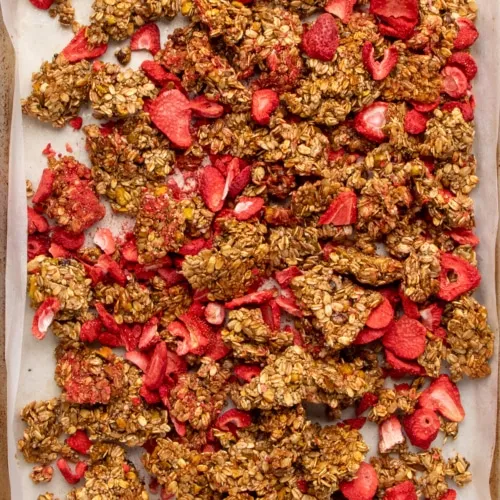
I refuse to pay nine dollars for a bag of store granola that is half oat dust.
Open any commercial pouch from the grocery store. You get three small clusters, a bunch of dry brown powder, and maybe two shriveled dried strawberries that stick to your teeth.
On Monday mornings at Sweety's Bakery, we roast twenty pounds of granola for our breakfast crowd.
Our sheet pans come out of the oven covered in giant golden slabs that we break by hand into crunchy clusters.
How do you get big clusters without dumping half a cup of corn syrup into your bowl?
Egg whites.
I take two egg whites and whip them with maple syrup and melted butter until they turn foamy. Then I dump the oats in and mix with my hands.
The foamy whites coat every oat flake. In a 300-degree oven, that egg wash hardens into big crunchy chunks that snap apart in your fingers.
Once the oats are stone cold, throw the freeze-dried strawberry slices into the bowl. Hot pans ruin fruit crispness fast. Cold pans keep every bite loud and crunchy.
Quick Baker's Notes for Best Results
- Berry Puree Reduction: Simmer 250g fresh strawberries down to exactly 110g (a 55% water reduction).
- Cluster Binding Catalyst: 1 large egg white (30g) whisked until frothy before folding into oats.
- Dehydration Bake Temperature: 300°F (149°C) for 35 to 40 minutes on the center oven rack.
- Stirring Frequency: Exactly 0 stirs during the bake (stirring destroys cluster matrix formation).
The Cluster Science: Why Most Homemade Granola Fails
If your granola bakes into individual loose oat flakes, your recipe is missing a cohesive binder and drying out too quickly.
1. Water Is the Enemy of Crunch
Fresh strawberries are 91% water. If you pour raw strawberry puree onto rolled oats, the water steams the oat starches in the oven, making them soft and chewy rather than crisp. By simmering your berries on the stove until reduced by more than half, you drive off the water while concentrating natural fructose and pectin, creating a sticky, viscous syrup that glazes the oats without waterlogging them.
2. The Egg White Secret
Here is the professional pastry chef's secret to giant clusters: one whipped egg white.
As detailed in the Serious Eats granola science and egg white cluster formation guide, egg whites are composed of water and albumin protein. When whipped until frothy and folded through the grains, the proteins coat the oat flakes. In the heat of the oven, those proteins coagulate and form an invisible, rigid matrix that glues the oats, nuts, and seeds together into massive, brittle sheets.
3. The Sugar-Glass Transition
Granola does not crisp up inside the oven; it crisps up on the counter after it cools. As the melted sugars (maple syrup, honey, and reduced fruit fructose) cool from 300°F down to room temperature, they transition into an amorphous solid state known as "sugar glass." If you stir the pan while it is hot, you shatter those sugar bonds before they can solidify.
Sourcing Certified Gluten-Free Oats and Freeze-Dried Fruit
Because oats are frequently harvested and processed on equipment shared with wheat and barley, anyone with celiac disease must use Certified Gluten-Free Rolled Oats. Review the Celiac Disease Foundation guidelines on certified gluten-free oats for safe sourcing standards.
To provide that final pop of intense fruit flavor, we fold in freeze-dried strawberries after the granola is baked and completely cooled. Never bake freeze-dried fruit in the oven; the delicate sugars burn to a bitter cinder within ten minutes. According to data from USDA FoodData Central nutrient profiles for freeze-dried strawberries, freeze-drying removes 98% of the water while locking in 100% of the natural vitamin C and tart berry aromatics.
Ingredients
Never use volume cups for granola production. A cup of rolled oats can vary by up to thirty grams depending on how settled the bag is. Measure all ingredients using our density-accurate cups to grams converter.
For the Berry Reduction Glaze:
- Fresh or Frozen Strawberries (chopped): 250 grams
- Pure Maple Syrup: 70 grams (approx. 1/4 cup)
- Raw Honey: 40 grams (2 tablespoons, provides viscosity)
- Refined Coconut Oil (melted): 55 grams (1/4 cup)
- Apple Cider Vinegar: 5 grams (1 teaspoon, brightens fruit acidity)
- Pure Vanilla Extract: 5 grams (1 teaspoon)
- Fine Sea Salt: 3 grams (0.5 teaspoon)
For the Dry Cluster Base:
- Certified Gluten-Free Rolled Oats (old-fashioned): 300 grams (approx. 3 cups)
- Raw Shelled Pistachios (roughly chopped): 65 grams (1/2 cup)
- Raw Pumpkin Seeds (Pepitas): 45 grams (1/3 cup)
- Hemp Hearts (hulled hemp seeds): 30 grams (3 tablespoons)
- Egg White (from 1 large egg): 30 grams (whipped until frothy)
- Freeze-Dried Strawberries (sliced): 30 grams (approx. 1 cup, folded in at the end)
Step-by-Step Instructions
1. Cook Down the Strawberry Reduction
Add the 250 grams of chopped strawberries and apple cider vinegar to a small heavy-bottomed saucepan over medium heat. Bring to a simmer, mashing the berries with a fork as they soften.
Cook down, stirring frequently, for 12 to 15 minutes until the fruit collapses into a thick, glossy jam-like paste. Weigh the pan: the reduction should weigh approximately 110 grams (a 55% loss of water).
Remove from heat. Whisk in the maple syrup, honey, melted coconut oil, vanilla extract, and fine sea salt until smooth. Let the mixture cool for 10 minutes.
2. Combine the Grains and Seeds
Preheat your oven to 300°F (149°C). Line a large, heavy rimmed baking sheet (half-sheet pan, 18x13 inches) with unbleached parchment paper.
In a large mixing bowl, combine the certified gluten-free rolled oats, chopped pistachios, pumpkin seeds, and hemp hearts.
3. Whip the Egg White and Emulsify
In a small clean bowl, whisk your single egg white vigorously with a fork for 30 seconds until it transforms into white, frothy foam with no liquid pooling. Pour the frothy egg white directly into the dry oat mixture. Toss with a spatula to coat every flake.
4. Glaze and Press
Pour the warm strawberry reduction over the oats. Using a wide silicone spatula, fold the mixture thoroughly for two minutes until every single oat flake and seed glistens with red berry glaze.
Dump the granola onto your parchment-lined baking sheet. Spread it into an even layer, leaving no bare spots.
The Compression Step: Take a second sheet of parchment paper, place it over the top of the granola, and use the flat bottom of a measuring cup or your palms to press down firmly across the entire tray. You want to compact the granola into one dense, cohesive, uniform slab roughly 1/2 inch thick. Peel away and discard the top parchment sheet.
5. The Low-and-Slow Dehydration Bake
Slide the tray into the center rack of your oven and bake at 300°F (149°C) for 35 to 40 minutes.
DO NOT STIR THE TRAY. Resist every urge to take a spoon to the pan. You want the slab to bake intact. The granola is finished when the edges are deep golden brown and the center feels dry to the touch (it will still feel slightly soft when pressed hot).
6. The 1-Hour Cooling Window and Cluster Break
Remove the baking sheet from the oven and set it on a heatproof wire rack. Do not touch the pan for one full hour.
As the tray cools, the albumin protein bonds and sugar-glass matrix solidify into a rock-hard, brittle sheet. Once the pan is completely cold to the touch, break the slab apart with your hands into giant, bite-sized clusters. Gently toss in the 30 grams of freeze-dried strawberry slices.
Store in an airtight glass jar at room temperature for up to four weeks.
Storage and Baker's Notes
Artisanal gluten-free granolas carry some of the strongest profit margins in specialty food retail, frequently retailing between $12 and $16 per 12-ounce kraft pouch. If you plan to sell bags at local markets, evaluate volume bundle margins with our bakery discount calculator for packaging farmers market bundles and track your raw ingredient and packaging overhead in our bakery profit margin calculator.
Storage and Serving Tips
Let the granola cool completely before transferring it to glass mason jars or airtight containers. Stored at room temperature in a cool, dry pantry, it stays crisp and fresh for up to 4 weeks.
If you sell baked goods or granola at farmers markets, you can track your batch overhead with our free Bakery Profit Margin Calculator or calculate multi-bag bundle promotions with our Bakery Discount Calculator.
Making your own crunchy strawberry granola at home is so much more rewarding (and delicious) than buying store-bought bags. Once you taste those giant, crisp clusters with sweet strawberries, it will become a regular in your morning rotation. Enjoy it over yogurt, with cold milk, or straight from the jar by the handful!
Baking or Selling This Recipe? Use Our Free Tools
Baking in Your Kitchen? Convert & Scale in Grams
Measuring cups can vary by up to 25% in flour weight. Convert cups to exact metric grams or scale this entire recipe (2x, 3x) in seconds.
Selling Custom Cakes? Price for Real Bakery Profit
Calculate ingredient food costs, packaging, and labor to set high-margin pricing for your home bakery or custom pastry orders.

Sara Ait Dahan
Professional Baker & Founder of Sweety's Bakery
Passionate about baking precision and culinary science, Sara founded Sweety's Bakery to empower home bakers and pastry chefs worldwide. Built from real bakery workbench experience, she creates tested gluten-free recipes, calibrated density calculators, and bakery business tools.