How to Cut a Mango Perfectly: Step-by-Step Guide & Gluten-Free Mango Crisp Recipe
2026-09-12
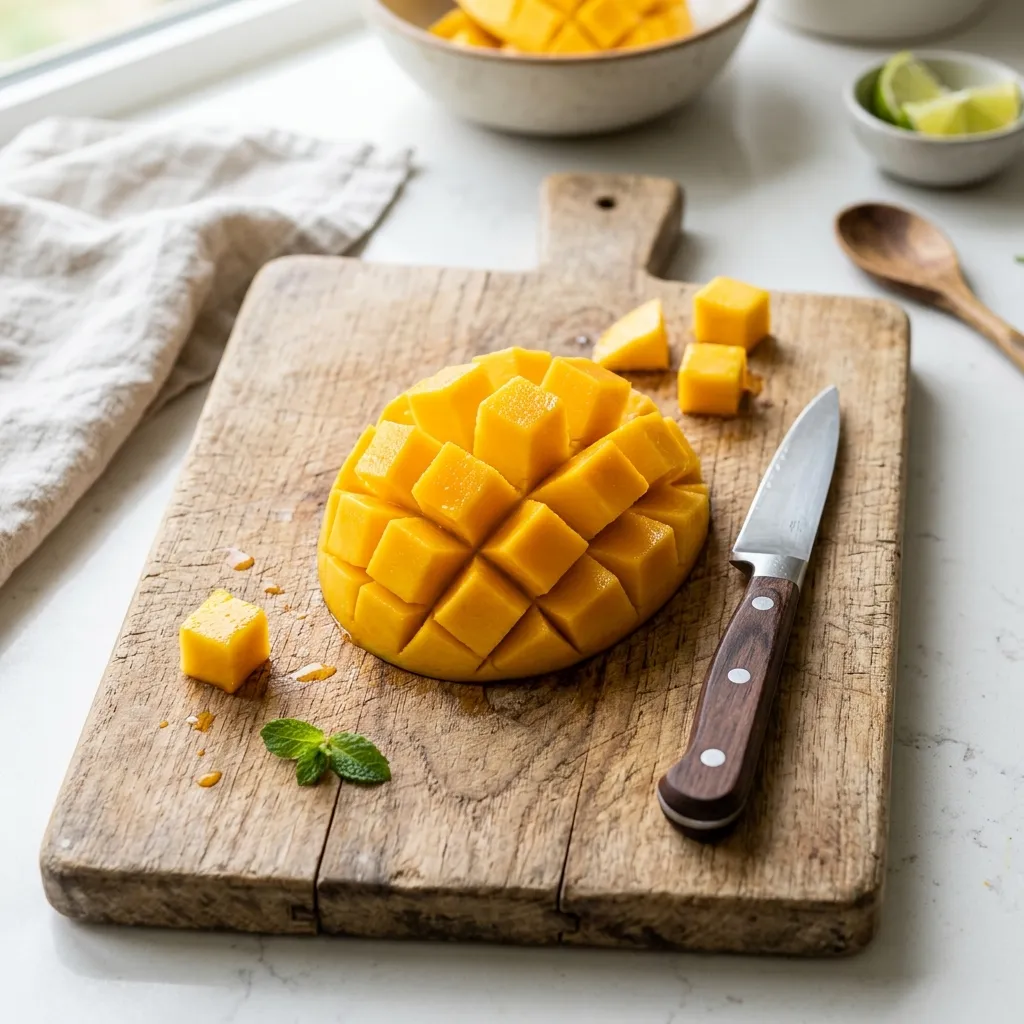
Cutting a fresh mango shouldn't look like a crime scene on your kitchen counter.
Most people hack into the fruit with a dull chef's knife. Sticky juice squirts across their forearms, and half the yellow pulp ends up mangled around the pit.
During summer mango season at Sweety's Bakery, we dice forty pounds of mangoes every Tuesday for fruit tarts.
A mango seed is weird. It isn't round. It is a long, flat woody oval.
I stand the fruit upright on our butcher block. I look straight down at the stem to spot the flat sides. Then I slice straight down a hair past the core.
The blade slides along the woody seed without biting into it. Two clean golden cheeks drop onto the board. No shredded pulp. No sticky mess.
Mango Processing & Yield Metrics
Logged across 50 whole mangos (varieties: Honey/Ataulfo and Kent) in our bakery test kitchen to evaluate knife yield and moisture release during baking.
Understanding Mango Anatomy and Ripeness
Before your knife touches the skin, you need to understand the internal architecture of the fruit. A mango (Mangifera indica) is a botanical drupe, meaning a fleshy fruit surrounding a single central woody endocarp (the stone).
The Geometry of the Stone
The seed inside a mango is not spherical like an avocado pit or peach stone. It is a wide, flat, oval disc that mirrors the exterior profile of the fruit. If you look down at a mango standing upright on its stem, you will notice an oblong silhouette: two wide curved sides (called the "cheeks") and two narrow sides (called the "shoulders"). The flat stone sits directly between those two cheeks.
How to Gauge Bakery-Ready Ripeness
Never rely on exterior skin color alone. A mango can be bright green and fully sweet, or deep crimson and rock-hard inside. Color is dictated by sun exposure during cultivation, not sugar conversion.
- The Gentle Palpation Test: Cup the fruit in your palm and apply gentle pressure with your thumb pad. A ripe fruit yields softly, similar to a ripe avocado or a relaxed palm. If it feels rock hard, the fruit lacks converted fructose; if your thumb leaves an indentation, it is overripe and better suited for smoothies.
- The Stem Aromatics: Sniff the stem end where the fruit was harvested. A ripe mango emits a fragrant, floral, honeyed scent.
- Nutritional Profile: According to the USDA FoodData Central raw mango nutrient breakdown, 100 grams of fresh mango flesh delivers roughly 14 grams of natural sugars alongside 60% of your daily ascorbic acid (Vitamin C). The riper the fruit, the higher the simple sugar concentration.
The Professional 4-Step Slicing Method
To execute clean cuts without bruising the delicate fruit fibers, you need a sharp 8-inch chef's knife or a 6-inch santoku knife. A dull blade slips across the waxy skin and crushes the cell walls, spurting juice across your counter.
Step 1: Establish a Stable Base
Wash the mango thoroughly under cold water to remove any surface orchard dust or natural tree sap. If the bottom stem end is uneven, slice off a razor-thin 2 mm sliver from the stem base so the fruit stands completely flat and stable on your cutting board without rolling.
Step 2: Orient and Cut the Two Cheeks
Stand the mango upright on your cutting board, stem-side down. Identify the wider, flatter axis of the fruit. The stone lies parallel to that flat plane. Position your chef's knife roughly 6 mm (1/4 inch) away from the imaginary center line. Slice straight down following the natural curvature of the stone. If your knife encounters woody resistance, nudge the blade 2 millimeters outward and resume slicing. Repeat the identical cut on the opposite cheek. You now have two pristine hemispheres of pure fruit flesh and a flat center slab containing the stone.
Step 3: Trim the Narrow Shoulders
Do not toss the center slab into the compost yet. Stand the center slab upright and slice down along the narrow edges (the shoulders) on either side of the pit. These two slender strips yield approximately 40 to 60 grams of extra fruit per mango. Trim the tough skin away from these strips with a paring knife and dice the meat.
Step 4: The Scoring and Inversion Technique
Hold one mango cheek cradled in your non-dominant hand or rest it flat on the cutting board. Using the tip of your knife, cut parallel vertical lines spaced 1 cm apart, slicing deep into the golden pulp without piercing through the outer skin. Turn the cheek 90 degrees and repeat crosswise to create a checkerboard grid.
Next, press your thumbs gently against the center of the skin side while pulling the outer edges down with your fingertips. The cheek inverts smoothly, popping the cubes outward like a golden hedgehog. Slice the elevated cubes cleanly off the skin into a bowl using a flexible pairing knife or scoop them with a large spoon in a single pass. For commercial post-harvest guidelines and peeling techniques, consult the National Mango Board commercial culinary and ripening guide.
Interactive Mango Yield & Crisp Batch Scaler
Enter the count or raw weight of your fresh whole mangos to calculate estimated edible fruit yield, crumble topping ratios, and required baking dish size.
The Bakery's Gluten-Free Mango Coconut Crisp Recipe
When you have a bowl of fresh, sweet diced mango cubes, baking them under a crunchy oat and toasted coconut streusel is pure pastry comfort. Mango has a high water content and softens considerably during baking, which means the filling requires a precise starch binder to avoid a soupy bottom.
Accurate ingredient weighing in grams is critical to achieve the perfect crumble texture without drying out the fruit. Convert any cup measurements seamlessly with our free cups to grams converter.
The Tropical Fruit Filling
- Fresh Diced Mango (600 g / roughly 4 medium Kent mangoes): Cut into uniform 1.5 cm cubes.
- Fresh Lime Juice (15 ml / 1 tbsp): Citric acid balances natural mango fructose and prevents thermal enzymatic browning.
- Tapioca Starch or Arrowroot (12 g / 1 tbsp): Tapioca starch cooks clear and glossy at 74°C, creating a luxurious fruit gel that holds its structure when sliced, adhering to fruit ratio standards from the King Arthur Baking fruit crisp and crumble structural ratio guide.
- Pure Maple Syrup (30 ml / 2 tbsp): Provides woodsy sweetness without graininess.
- Pure Vanilla Extract (5 ml / 1 tsp)
The Gluten-Free Coconut Oat Streusel
- Certified Gluten-Free Rolled Oats (100 g / 1 cup): If you love making hearty oat toppings and breakfast crisps, check out our popular bakery guide for crunchy strawberry granola.
- Blanched Fine Almond Flour (50 g / 1/2 cup): Provides rich nut fats that mimic the crumb structure of wheat flour.
- Unsweetened Shredded Coconut (35 g / 1/3 cup): Toasts into a fragrant, nutty crust during baking.
- Coconut Palm Sugar or Light Brown Sugar (50 g / 1/4 cup): Caramelizes with the oat flakes.
- Unsalted European Butter or Virgin Coconut Oil (60 g / 1/4 cup): Melted and cooled slightly.
- Ground Cinnamon (2 g / 1/2 tsp) & Sea Salt (1.5 g / 1/4 tsp)
Step-by-Step Assembly and Baking
Step 1: Pre-Gelatinize the Fruit Matrix
Preheat your convection oven to 175°C (350°F / Gas Mark 4). In a large glass bowl, gently fold together the fresh diced mango, fresh lime juice, maple syrup, vanilla extract, and tapioca starch. Toss until every mango cube is coated in a faint milky sheen of starch slurry. Transfer the fruit into a lightly greased 8-inch square ceramic or glass baking dish, leveling the top with a spatula.
Step 2: Form the Clumpy Oat Streusel
In a separate mixing bowl, whisk together the gluten-free rolled oats, fine almond flour, unsweetened shredded coconut, coconut sugar, ground cinnamon, and sea salt. Drizzle the melted butter or coconut oil over the dry ingredients. Mix with a fork until the fat hydrates the almond flour, forming distinct, crumbly clusters roughly the size of hazelnut shells.
Step 3: Layer and Bake
Scatter the streusel evenly across the mango filling, leaving tiny peek-a-boo gaps around the perimeter so steam can vent freely. Bake uncovered for 32 to 35 minutes. You will know the crisp is done when the oat topping is deep golden brown and thick, glossy mango bubbles erupt vigorously around the edges of the pan.
Step 4: Rest and Serve
Remove the dish from the oven and set it on a wire cooling rack for 15 minutes before serving. Resting allows the tapioca starch gel to set completely. Spoon warm into bowls alongside dairy-free vanilla gelato or whipped coconut cream.
Kitchen Production Economics for Seasonal Fruit Crisps
Catering and cottage baking businesses frequently miss out on substantial profit by failing to price seasonal fruit desserts accurately.
Batch Costing (6 Portions / 8-inch Pan)
- Fresh Mangoes (4 whole Kent): $4.80
- Gluten-Free Oats, Almond Flour & Coconut: $1.75
- Organic Butter / Coconut Oil & Sweeteners: $1.25
- Starch, Lime & Spice: $0.40
- Total Ingredient Pan Cost: $8.20 ($1.37 per portion)
Retailing individual heat-and-eat crisp portions at $6.50 yields $39.00 in gross revenue against an $8.20 food cost, representing a 79% gross profit margin. To audit your packaging overhead, utility costs, and seasonal markups, run your numbers through our bakery profit margin calculator.
Kitchen Tips and Leftover Mango Storage
Store diced mango in an airtight glass container in the refrigerator for up to 5 days. For long-term storage, spread the diced fruit in a single layer on a parchment-lined baking sheet, freeze until solid (about 2 hours), and transfer into a freezer bag for up to 6 months of instant smoothie additions.
Once you know how to navigate around the flat mango seed, slicing fresh mango becomes second nature. Whether you eat the juicy slices as-is, blend them into smoothies, or fold them into a warm gluten-free fruit crisp, fresh mango is always a bright, delicious addition to your kitchen!
Baking or Selling This Recipe? Use Our Free Tools
Baking in Your Kitchen? Convert & Scale in Grams
Measuring cups can vary by up to 25% in flour weight. Convert cups to exact metric grams or scale this entire recipe (2x, 3x) in seconds.
Selling Custom Cakes? Price for Real Bakery Profit
Calculate ingredient food costs, packaging, and labor to set high-margin pricing for your home bakery or custom pastry orders.

Sara Ait Dahan
Professional Baker & Founder of Sweety's Bakery
Passionate about baking precision and culinary science, Sara founded Sweety's Bakery to empower home bakers and pastry chefs worldwide. Built from real bakery workbench experience, she creates tested gluten-free recipes, calibrated density calculators, and bakery business tools.